
My Twin Got Everything While My Parents Locked Me Away
Content warnings
- Manipulation
POV: YOUR PARENTS LOVES YOUR TWIN SISTER MORE
Chapter 1
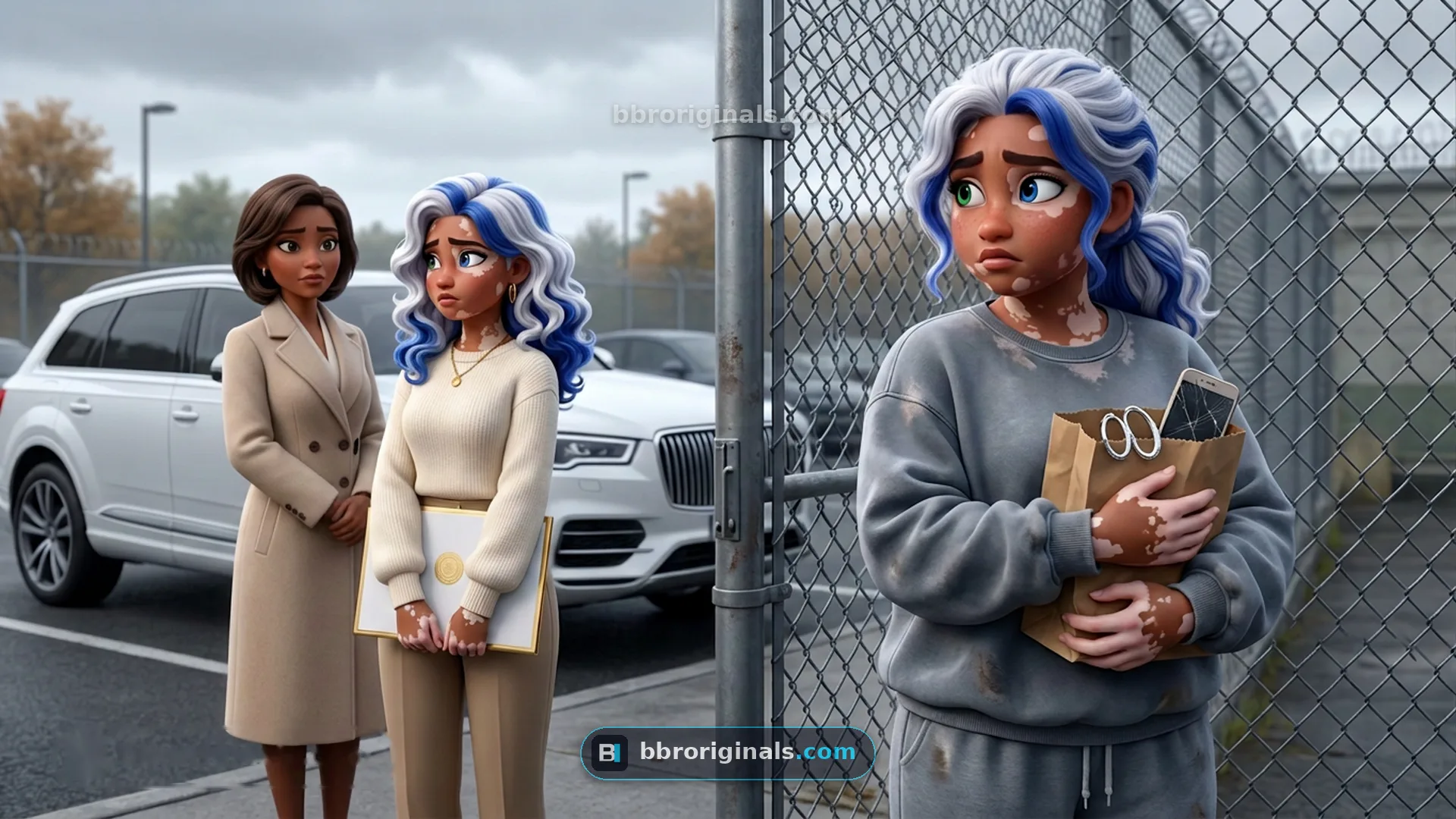
The day I walked out of the Pine Creek Juvenile Correctional Facility, I turned twenty years old.
A guard handed me a brown paper bag with the silver hoop earrings and the dead cell phone they had taken off me when I was seventeen, buzzed the wire gate open, and told me not to come back.
Outside the fence, my mother's white SUV was parked at the far end of the visitor lot, away from the other families, like she was still afraid somebody from our church might drive past and recognize her license plate.
My mom was standing by the hood in her beige wool coat, twisting her wedding ring around her knuckle.
Standing right next to her was my identical twin sister, Tessa.
If you have never had an identical twin, it is hard to explain what it feels like to look at your own face after you've been locked up for three years.
When you're inside a state facility, the mirrors above the bathroom sinks are just polished sheets of scratched aluminum attached to the concrete wall.
You can barely see what you look like.
So walking across that parking lot and seeing Tessa was like looking at a high-definition photograph of the person I was supposed to be if my life hadn't ended on a dark two-lane road in senior year.
We had the exact same dark brown hair, the same narrow chin, the same little scar under our left eyebrow from when we bumped heads on a trampoline when we were six.
Except Tessa's hair was shiny and curled around her shoulders, and she was wearing a clean cream-colored sweater.
My hair was tied back with an old black rubber band, and I was wearing the oversized gray sweatpants and sneakers the state gives you when you outgrow the jeans you got arrested in.
"Happy birthday, baby," my mom whispered when I reached the car.
She hugged me fast and stiff, patting my back twice before letting go.
"Look at you. You're finally home. Your dad has asked the butcher to prepare a special cut of beef for dinner tonight."
I didn't care about the special beef.
I was looking past my mom's shoulder at my sister.
"Hey, Tess," I said.
Tessa didn't hug me.
She didn't even step forward.
She kept her arms wrapped tight around her ribs, staring down at the ground between my cheap sneakers, and mumbled, "Hey, Mara."
She wouldn't look me in the eye.
Not when we got into the car, not when I sat in the backseat behind her for the forty-minute drive home, and not when I watched the side of her face in the rearview mirror.
Every time my eyes caught hers in the glass, she jerked her head toward the passenger window and stared at the trees.
Sitting in the back of that quiet car, feeling the rough fabric of my state sweatpants against my knees, a cold, sick feeling settled in the bottom of my stomach.
For thirty-six months, while I ate cold oatmeal off trays and broke up fights in the laundry room, I had told myself one thing to keep from losing my mind:
I did it so Tessa could have a life.
Now I was looking at the back of my sister's head, and she couldn't even stand to look at my face.
To understand how I ended up in that detention center while Tessa got a full ride to college, you have to understand how our house worked from the day we were born.
We grew up in a small town where everybody knows whose car is parked in whose driveway.
My dad, Richard, was a head deacon at First Baptist and owned the biggest insurance agency in the county.
His face was on billboards out by the bypass and on the back of all the Little League jerseys.
My mom ran the hospital charity guild.
In a house like ours, how things looked from the street mattered way more than how things actually were inside the walls.
When you have identical twins, people love to split you into two neat halves so they can tell you apart.
By the time we were eight years old, our parents had already picked our roles.
Tessa was the gentle one, the gifted one, the fragile girl who got straight A's, played the flute, and cried if somebody raised their voice at her.
I was the strong one.
The mouthy one.
The screw-up who got grass stains on her church dresses and talked back when things weren't fair.
Whenever adults asked me a question—teachers, doctors, people in the church lobby—my dad had this habit of stepping right in front of me and answering for me before I could even open my mouth.
"How does Mara like tenth-grade biology?" the pastor would ask after service.
Dad would put his hand on my shoulder, squeeze hard enough that I knew to stay quiet, and laugh.
"Oh, you know Mara. Book work isn't really her thing, Pastor. She's our free spirit. Tessa's the one pulling a ninety-nine average in honors chemistry."
I learned really early that my job in our family was to absorb all the bad stuff so Tessa could stay spotless.
When we were eleven, Tessa was sneaking cookies out of the dining room and dropped my grandmother's crystal boat onto the floor.
It broke into twenty pieces.
By the time my dad came stomping down the hall with his belt unbuckled, Tessa was hyperventilating in the corner, her face turning purple like she couldn't breathe.
So I stepped in front of the broken glass and told my dad I had knocked it over reaching for a quarter.
I took the grounding and the yelling without crying once, because I told myself I was tougher than she was.
Two weeks before the crash in our senior year, a white envelope from Emory University showed up in the mail.
Tessa had gotten an early-decision academic scholarship.
My dad lost his mind with pride.
He took the letter down to the frame shop on Main Street, had it put inside a gold frame, and hung it right in the front entryway of our house so it was the very first thing anybody saw when they walked through the front door.
That Saturday, my parents threw a dinner for thirty people at the country club to brag about their future doctor.
I remember walking into the club bathroom halfway through dessert and finding Tessa sitting on the tile floor inside a locked stall with her knees pulled up to her chest, dry-heaving into the toilet.
"Tess?"
I whispered, slipping under the stall door and holding her hair back.
"Did you eat bad shrimp?"
She wiped her mouth with the back of her hand, shaking all over.
"I didn't even want to apply to Emory, Mara," she whispered, staring at the tiles.
"Dad filled out half the application on my laptop while I was at track practice. I don't want to go to Georgia. I don't want to be a doctor. I feel like I can't breathe."
I gave her a wet paper towel, patted her cheek, and told her, "Just smile through the cake, Tess. Once we graduate, we'll figure it out together."
Ten days later, a boy named David Peters was dead in a ditch on Route 4, and my parents figured out a completely different plan.
© 2026 BBR Originals. This story is protected by copyright. Please share the link rather than copying the text. Content-use policy
More stories like this
Marriage & Relationships
While I Was in a Coma, My Husband Gave Away My Kids
POV: YOUR HUSBAND TOOK YOUR KIDS FROM YOU
Content warnings
- Childhood neglect
Marriage & Relationships
I Married the Man Who Saved Me—Then Learned He Staged the Attack
POV: YOU MARRIED YOUR ATTACKER!
Content warnings
- Emotional abuse
- Violence
- Manipulation
Family & In-Law Conflict
I Found Letters From a 40-Year-Old in My Teen Daughter’s Backpack
POV: YOUR TEENAGE DAUGHTER IS IN LOVE WITH A 40 YEAR OLD MAN
Reader comments
Share what this story brought up for you. Please be kind to other readers. Links are not allowed. We may remove comments that break these rules.
No comments yet. You can be the first to write one.
Write a comment