
Chapter 5
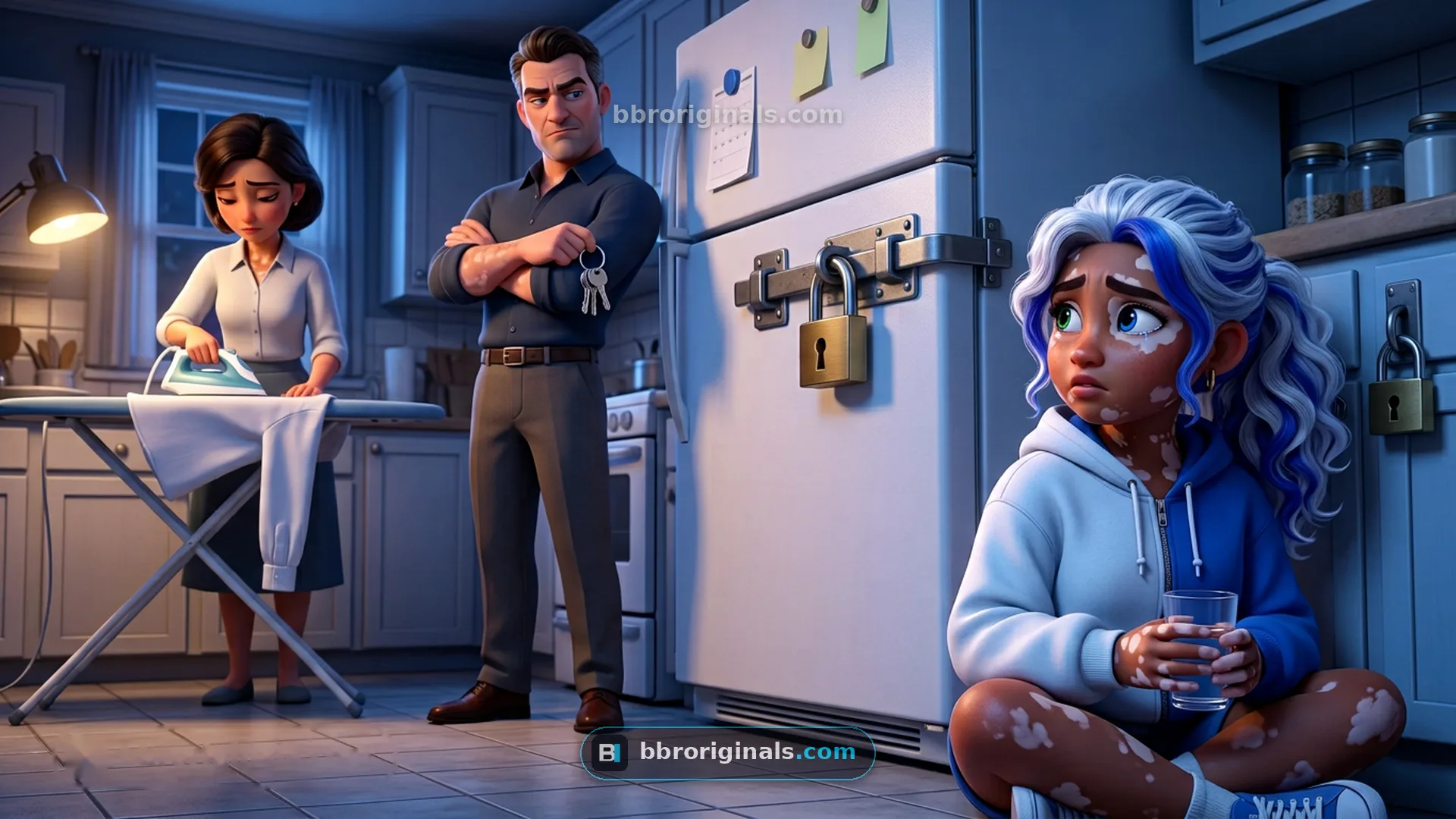
I didn't pull my handbag back when Ray grabbed the strap.
Instead, I took one step closer to him and lifted my right hand so my phone screen was three inches from his face.
The bright screen showed a video recording that was already two minutes long, with the red numbers still counting up at the top.
Right behind Ray's angry red face in the video, you could clearly see the padlocks hanging on the refrigerator and the food cupboards.
"Look at the screen, Ray," I said, keeping my voice low and steady even though my heart still pounded loudly.
"I started recording on my way down the stairs. Every word you just said about owning my mother is already saved to my private online account. Even if you break my phone right now, you can't delete it."
Ray froze.
His hand stayed wrapped around my bag strap, but the anger in his eyes turned into sudden fear.
"What are you doing?" he asked, his voice dropping low.
"This is private family business, Naomi."
"No, it's not," I said.
"You spent twenty years hiding behind your clean Sunday suits because you care more about what people at church think of you than anything else in the world. Let go of my bag and open that back door right now."
"And if I don't?" he whispered, trying to look tough, though his fingers were already loosening on the strap.
"If you aren't away from that door in five seconds, I'm sending this video to the pastor, the church elders, and every single neighbor on this street before sunrise tomorrow," I said.
"Everyone at Sunday service will see the locks you put on your dying wife's kitchen cabinets, and I'll show them the house loan papers you used to trap her. Go ahead and test me."
For three seconds, neither of us breathed.
Ray looked at the camera lens, then looked at the padlock on the refrigerator beside his shoulder.
He just looked like a mean, cowardly old man.
Slowly, he opened his fingers and let go of my handbag.
Without saying a word, he reached behind his back, turned the metal lock on the kitchen door, and took two big steps away from it.
I didn't take my eyes off him until I backed out, walked through the dark yard, and locked myself inside my car down the street.
At seven o'clock the next morning, I walked back into Room 402 at the hospital.
Ray was already there, standing stiffly against the far wall by the window with his arms crossed.
When I walked in, he didn't smile, and he didn't call me his little girl.
He just looked down at his shoes and stayed in the corner, too scared of what was on my phone to say a single word to me.
I pulled the chair right up against the side of my mother's bed and sat down, making sure I could still see the hallway door.
My mother's breathing was very slow and shallow now.
Her eyes were half-closed, staring weakly at the ceiling.
I reached out and took her thin, cold hand in mine.
It felt as light as a dry leaf.
"Mom," I whispered, leaning close to her face.
"Look at me for a second."
Slowly, her cloudy eyes moved until she found my face.
With my other hand, I pulled the zipper of my handbag open just three inches—facing away from Ray so he couldn't see—and lifted the corner of the faded blue bank book inside.
"I went to the house last night," I whispered right into her ear so only she could hear me over the quiet beeping of the machines.
"I found the loose board under the window. I read your letter, and I have the blue book right here in my bag."
My mother's dry lips parted slightly, and a single clear tear slipped out the corner of her eye and rolled down into her gray hair.
"I know why you couldn't leave, Mom," I whispered, my throat burning as my own tears started falling onto her white bedsheet.
"And I know you were starving right beside me the whole time. You don't have to be scared anymore. I'm safe now, and he can't hurt me."
She didn't have the strength to talk anymore, but her thin fingers squeezed my hand once, holding on with everything she had left.
Then she closed her eyes, let out a long, quiet breath, and the tight lines around her mouth finally went soft.
I kept holding her hand, lifted my head, and looked straight across the bed into Ray's eyes.
"My mother wanted me to sit in this room with you before she died, so here I am," I said out loud, my voice clear in the quiet room.
"Wait until you hear this part, Ray. I will never forgive you for what you did to us. Not today, not ever. The minute my mother stops breathing, you are completely dead to me."
Ray stared back at me from the corner with a pale face and said nothing.
My mother died peacefully in her sleep two days later.
On Saturday morning, Ray sat in the very front row of the funeral chapel in his black suit, holding a tissue to his eyes and waiting for me to come sit beside him so we would look like a grieving family in front of his church friends.
I didn't sit anywhere near him.
Two hours before the service started, I had gone to the bank, closed the savings account with my mother's passbook, and walked straight into the funeral director's office with the three thousand four hundred and twenty dollars in cash.
I paid for my mother's burial myself so Ray couldn't claim he paid for it, and I ordered a small stone for her grave that had only her first and old family name on it:
GRACE JOHN.
After paying the funeral home, there was six hundred dollars left from the money my mother had starved herself to save.
On my way out of town, I didn't give a penny of it to her church.
Instead, I stopped at a small local women's shelter near the bus station that gave out free groceries to single mothers, handed them the envelope of cash, and told them to write the receipt in Grace John's name.
At the cemetery, when Ray tried to walk over to me by my car and whispered, "Naomi, wait a minute,"
I didn't even turn my head.
I got into the driver's seat, locked the doors, and drove back to Chicago without looking in my mirror.
Three days later, on Tuesday afternoon, I was sitting alone in my car in the supermarket parking lot in Chicago, ten minutes before my two o'clock shift started.
I wish I could say that finding that blue bank book fixed everything inside me and made the bad memories go away.
It didn't.
I was completely exhausted, and my eyes were swollen from crying in my apartment for three days straight.
Half of me felt sick with guilt for hating my mother for twelve years when she had been starving in secret to save me.
The other half of me was still so angry at her—and at a church full of blind people—that I wanted to hit the steering wheel until my hands bled.
Why did she have to suffer for eleven years just to save three thousand dollars?
Why did nobody in that house or that town ever step in to save a hungry nine-year-old girl?
I checked my side mirrors to make sure nobody was walking near my car, and my eyes automatically checked the street exit at the end of the parking lot out of habit.
Knowing the truth didn't stop me from checking for the exits.
It didn't make me trust people, and it didn't make me want to step foot inside a church ever again.
I reached down into my handbag on the passenger seat.
My fingers brushed past the faded blue paper bank book I still carried with me, and closed around a small plastic packet at the bottom of the bag.
I tore open the plastic wrapper with shaking fingers, ate one dry cracker in the quiet car, and wondered how many years it takes to finally stop feeling like a starving nine-year-old locked out of the kitchen.
More stories like this
Family & In-Law Conflict
My Addiction Became a Gossip
POV: EVERYONE KNOWS YOUR SECRET SIN
Family & In-Law Conflict
My Parents Gave My Newborn Baby To My Infertile Sister..
POV: YOUR SISTER TOOK YOUR CHILD BECAUSE SHE IS INFERTILE
Content warnings
- Domestic abuse
- Reproductive decisions
Personal Confessions & Emotional Wounds
I Pretended To Be Rich… And Got Kidnapped For Ransom
POV: YOU PRETENDED TO BE RICH AND THEN GOT KIDNAPPED
Content warnings
- Violence
© 2026 BBR Originals. This story is protected by copyright. Please share the link rather than copying the text. Content-use policy
Reader comments
Share what this story brought up for you. Please be kind to other readers. Links are not allowed. We may remove comments that break these rules.
No comments yet. You can be the first to write one.
Write a comment